The Ultimate Setup Guide for Your Baby Kangaroo 2.0 Tactile
The mechanical keyboard landscape is one of constant evolution, where the tactile bump is considered the holy grail for enthusiasts and professionals alike. Among the myriad of switch options available, the Gateron Baby Kangaroo has maintained a legendary status for its crisp, snappy feedback and unique acoustic profile. With the release of the Baby Kangaroo 2.0 Tactile, the stakes have been raised once again. This iteration isn't just a minor refresh; it represents a refined approach to material science and structural engineering in the world of enthusiast-grade switches. Whether you are a software developer seeking that perfect feedback for every line of code or a writer looking for a rhythmic typing experience that keeps the creative juices flowing, the Baby Kangaroo 2.0 is designed to bridge the gap between heavy industrial tactility and modern smooth operation.
Setting up these switches requires more than just popping them into a hot-swap PCB. To truly unlock the potential of the 2.0 version, users must understand the nuances of the dual-stage gold-plated spring, the upgraded POM stem material, and how the PC/Nylon housing interacts with different plate materials. This guide provides a comprehensive deep dive into the technical specifications, the physical installation process, and the optimization techniques necessary to ensure your keyboard feels as premium as the engineering inside the switch itself.
An Analysis of the Baby Kangaroo 2.0 Tactility
The core identity of the Baby Kangaroo 2.0 Tactile lies in its high-position tactility. Unlike traditional brown-style switches where the bump occurs halfway through the travel, the Baby Kangaroo 2.0 features a bump that is felt almost immediately upon pressing the key. This "early bump" design is achieved through a meticulously curved stem leg that interacts with the metal leaf at a sharper angle. When combined with the weighted dual-stage spring, the result is a switch that resists the initial press just enough to provide a satisfying "pop" before dropping into a smooth bottom-out.
The 2.0 version brings several key upgrades over the original. First, Gateron has improved the "factory lube" process. While many enthusiasts usually prefer to strip and re-lube switches, the Baby Kangaroo 2.0 features a more consistent application of lubricant on the sliders and the spring. This reduces the scratchiness that is common in mass-produced tactile switches and eliminates "spring ping," a high-pitched metallic echo that can plague deep-sounding keyboard builds. Furthermore, the housing tolerances have been tightened. There is significantly less stem wobble in the 2.0 version, which is a critical factor for users who use tall keycap profiles like SA or MT3, where even minor wobble is amplified.
Acoustics are the other half of the equation. The material choice—a blend of Polycarbonate for the top housing and Nylon for the bottom—creates a "clack" that is bright but well-rounded. It avoids the shrillness of all-polycarbonate switches while maintaining a higher pitch than the muted "thock" of all-nylon housings. This makes it an exceptionally versatile switch for different case materials, whether you are using a heavy aluminum chassis or a more resonant frosted acrylic base.
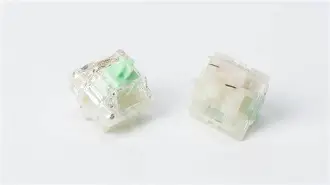
Pros and Cons of the Baby Kangaroo 2.0
- High-Quality Factory Lubrication: One of the strongest selling points is that these switches are ready to use out of the box. The automation Gateron uses for the 2.0 series ensures that the leaf and spring are coated sufficiently to prevent rattle without Turning the tactile feel mushy.
- Exceptional Snappiness: The 22mm dual-stage spring provides a very fast return. This means the key follows your finger back up almost instantly, making it feel highly responsive during rapid typing sessions.
- Clear Top Housing for RGB: For users who appreciate per-key lighting, the transparent PC top housing allows for excellent light diffusion, making it a great choice for backlit gaming setups or aesthetic-focused workstations.
- Durability: Gold-plated contacts and high-quality POM stems ensure that the tactile leaf won't lose its "bite" over millions of keystrokes, addressing a common complaint with cheaper tactile clones.
- High Price Point: Compared to budget tactile switches, the Baby Kangaroo 2.0 is a premium investment. For a full-sized keyboard, the cost of the switches alone can rival the cost of an entry-level mechanical keyboard.
- Potential Fatigue: The aggressive tactile bump and the 59g bottom-out force can be tiring for users who are used to light linear switches (like Cherry Reds) or standard membrane keyboards. It requires a more deliberate typing style.
- Loudness: Because of the snappy return and material choice, these are not silent switches. They have a distinct "pop" that may be too loud for a quiet office environment or a shared bedroom.
Technical Comparison: 2.0 vs. The Competition
To understand where the Baby Kangaroo 2.0 fits in the market, it is helpful to compare it to other popular tactile switches that enthusiasts often consider. Typical metrics include the actuation force (the weight needed to register the key) and the tactile force (the peak of the "bump").
| Switch Model | Tactile Peak Force | Actuation Force | Spring Type | Best Use Case |
|---|---|---|---|---|
| Baby Kangaroo 2.0 | 67g | 59g | 22mm Dual-Stage | General Typing & Productivity |
| Glorious Panda | 70g | 60g | Standard Single-Stage | Heavy Typists / "Thock" Enthusiasts |
| Cherry MX Brown | 55g | 45g | Short Single-Stage | Office Professional / Light Touch |
| BobU U4T | 65g | 62g | Standard Long Spring | Acoustic-Focused Builds |
The Ultimate Setup Process
Step 1: Inspecting and Sorting
Before beginning the installation, it is vital to inspect your switches. With any mass-produced mechanical component, there is a small chance of bent pins. The Baby Kangaroo 2.0 features a 5-pin design, meaning it has two extra plastic legs for stability. If your PCB only supports 3-pin switches, you will need to carefully clip these extra plastic legs with a pair of flush cutters. Check each metal pin to ensure they are perfectly vertical. Even a slight tilt can cause the pin to crumple when pushed into the hot-swap socket, potentially damaging the socket itself.
Step 2: Preparing the PCB and Plate
For the best experience with the Baby Kangaroo 2.0, the choice of plate material is paramount. Because these switches have a very sharp tactile event, pairing them with a stiff stainless steel or brass plate can result in a "harsh" feel that might vibrate through your fingertips. To balance the snappiness of the switch, many enthusiasts recommend a FR4 (fiberglass) or Polycarbonate plate. These materials offer a bit of "flex," which absorbs the shock of the bottom-out and creates a more comfortable typing experience over long periods. Before inserting the switches, ensure your stabilizers are well-lubed, as the distinct sound of the Baby Kangaroo will make any rattling spacebar sound significantly worse by comparison.
Looking for the best Electronics deals on Amazon?
View Offers →Step 3: Installation and Alignment
Align the switch over the socket, ensuring the Gateron logo is facing the correct direction relative to your North-facing or South-facing LEDs. Press down firmly in the center of the switch. You should feel a slight click as the housing snaps into the plate. It is a common mistake to press on the stem, which can lead to uneven pressure. Always press on the housing shoulders. Once all switches are installed, it is highly recommended to plug the keyboard into a computer and use a keyboard testing utility to ensure every key registers. If a key is not working, remove the switch and check for a bent pin—usually, straightening it and re-inserting it fixes the issue.
Step 4: Managing Acoustics
Because the Baby Kangaroo 2.0 has a very defined sound, the cavity of your keyboard case can act like a resonator. To focus the sound of the switches and eliminate "hollowness," consider adding a thin layer of PE foam between the switches and the PCB. This "PE Foam Mod" is famous for creating a marbly, "creamy" sound profile that complements the sharp tactility of the 2.0 version. Additionally, ensure there is some dampening material in the bottom of the case, such as silicone or poron foam, to prevent the switch's vibrations from bouncing off the bottom of the keyboard shell.
Buying Guide: Is This Switch for You?
Choosing the right switch is a subjective journey, but there are certain buyer profiles that the Baby Kangaroo 2.0 Tactile caters to perfectly. Before committing to a full set, evaluate your typing habits and environmental needs. Typically, users care about three primary factors: feel, sound, and effort.
The Professional Typist: If your job involves thousands of words a day, you likely want a switch that provides clear confirmation of a keypress. The Baby Kangaroo 2.0 is excellent for this because the tactile bump is so pronounced that you are less likely to "bottom out" with excessive force. Once you feel the bump, your brain knows the command was sent, allowing you to move to the next key. This can actually improve typing speed over time.
The Gamer: While many gamers prefer linear switches for their speed, many find that "spamming" keys is actually easier with a snappy tactile switch. The dual-stage spring in the Baby Kangaroo 2.0 excels here because the rapid return of the stem makes the switch feel incredibly "alive." However, if you play games that require holding down keys for long periods (like driving simulators), the 60g weight might become tiring.
The Sound Enthusiast: If you are building a keyboard specifically for the "ASMR" qualities of typing, these are a top-tier choice. They produce a high-frequency "clack" that sounds clean and crisp. They are far less "mushy" than rubber dome keyboards and have a much more sophisticated sound than a standard clicky switch (like a Blue switch), which can be annoying to others. The Baby Kangaroo provides the physical feel of a clicky switch without the piercing noise of a click-jacket.
Buyers should also consider the keycap material they intend to use. PBT keycaps are generally thicker and denser, which will deepen the sound profile of the Baby Kangaroo 2.0. Thin ABS keycaps will emphasize the high-end "clack." For a balanced experience, a high-quality set of doubleshot PBT keycaps in a Cherry or OEM profile is usually the safest bet for maximizing the tactile sensation without making the keyboard sound too "thin."
Discover deals on Electronics — updated daily.
See Deals →Advanced Customization and Maintenance
While the Baby Kangaroo 2.0 is advertised as a "plug and play" premium switch, the truly dedicated hobbyist might want to take things a step further. One of the most common advanced modifications is "filming." Although Gateron has improved the housing fit, adding a thin 0.125mm or 0.15mm switch film between the top and bottom housings can further solidify the sound and eliminate the tiniest micro-movements. This is particularly effective if you find the sound of your switches varies slightly across the board.
Maintenance is relatively straightforward. Because the housings are fairly tight, dust ingress is less of an issue than with older switch designs. However, if you find that a switch becomes "scratchy" after a year of heavy use, a tiny drop of high-quality synthetic oil (like Krytox 105) on the spring can revive that out-of-the-box smoothness. Avoid using heavy greases on the tactile legs, as this will coat the leaf and "round out" the bump, essentially defeating the purpose of buying a high-tactility switch in the first place.
Another consideration for long-term setup is the "break-in" period. Like a pair of high-quality leather boots, mechanical switches often have a sweet spot. The Baby Kangaroo 2.0 usually feels its best after about 50,000 to 100,000 keystrokes. During this time, the factory lube spreads more evenly and the plastic surfaces polish each other through friction. If the switches feel a bit stiff on day one, give them a week of solid typing before deciding to make any drastic changes to your setup.
Conclusion
The Baby Kangaroo 2.0 Tactile stands as a testament to how far mechanical switch technology has come. It successfully captures the nostalgic feel of vintage tactile keyboards while utilizing modern materials like POM and high-quality gold-plated springs to meet the demands of today's users. By focusing on a high-position tactile bump and a rapid, energetic return, Gateron has created a switch that provides a rhythmic, engaging typing experience that feels vastly different from the standard offerings found in most pre-built keyboards.
Setting up your keyboard with these switches is an investment in your daily interface with technology. By following a structured approach—selecting the right plate material, managing case acoustics, and ensuring a clean installation—you can create a tool that is not only functional but a joy to use. Whether you are finishing a novelist's manuscript, compiling complex code, or simply enjoying the tactile nature of a well-built machine, the Baby Kangaroo 2.0 provides the feedback and reliability required for a premium experience. As you settle into your first few hours of typing on your new setup, the refined "pop" and consistent feel of each keystroke will confirm that the effort put into the perfect setup was well worth it.